Slab Leak Water Damage Restoration in Laguna Hills & Orange County
Slab leak water damage starts when a pressurised water line leaks in or under the concrete slab your home sits on. A plumber finds and repairs or reroutes the pipe. PCH Restoration Team (PCH) dries the slab and the walls above it, removes damaged flooring, baseboard and drywall, and rebuilds under CSLB #935386.
What is a slab leak?
A slab leak is a leak in a water line that runs in or under a concrete slab foundation. Because the line is under pressure, water keeps flowing until the leak is found and the supply is shut off or repaired.
Most Orange County houses sit on a slab-on-grade foundation: a concrete slab poured directly on the ground, with no basement or crawl space under it. In many homes the copper supply lines that feed the kitchen, bathrooms and water heater run in or beneath that slab. When one of those lines develops a pinhole or a crack, the water has nowhere obvious to go.
So it moves sideways under the flooring and wicks up into baseboard, the bottom plate of the wall framing and the drywall above it. That is why slab leak damage is usually wider and lower than people expect, and why it is often found late. It is one of the losses we handle inside our residential water damage restoration work.
What are the signs of a slab leak?
The common signs are a warm spot on the floor, the sound of running water with every fixture off, a water bill that jumps for no reason, and damp flooring or baseboard with no source above it.
- A warm or hot spot on a hard floor, usually from a leaking hot-water line.
- Running or hissing water you can hear with every tap, toilet and appliance off.
- A water bill that rises without a change in use, often the first hard evidence.
- Damp carpet, lifting tile or cupping wood in one area, often near a wall.
- Swollen or stained baseboard and a musty smell close to the floor.
None of these proves a slab leak on its own; a plumber confirms it. Our guide to the signs of a slab leak explains each one and what to check before you call.
Which Orange County homes are most likely to have slab leaks?
Slab leaks are most common in slab-on-grade homes with supply lines in or under the concrete, and older original plumbing adds to the risk. Many homes in Laguna Hills, Mission Viejo and Lake Forest were built between the 1960s and the 1980s.
Laguna Hills grew out of the Moulton Ranch, which was subdivided in the early 1960s, so many homes near our water damage restoration in Laguna Hills base are now several decades old. Homes of that age may still have their original supply lines unless they have been repiped.
Much of Mission Viejo was completed by 1980, which puts a large share of homes served by our water damage restoration in Mission Viejo team past forty years. In Lake Forest, the first residential community was developed in the late 1960s, so the same age question applies to homes covered by our water damage restoration in Lake Forest crews.
Age is only one factor. Water chemistry, how the lines were installed and soil movement all play a part, and newer homes can leak too. A plumber is the right person to judge the condition of your pipes.
Who fixes the pipe and who fixes the water damage?
A plumber or leak detection company finds the leak and repairs or reroutes the pipe. PCH does not repair plumbing. We dry the structure, remove what cannot be dried, handle any mold and rebuild the finished rooms.
| Task | Who does it |
|---|---|
| Shutting off the water at the main | You, as soon as you suspect a leak |
| Finding the leak under the slab | A plumber or leak detection specialist |
| Spot repair through the slab, or a reroute through walls or attic | Your plumber, who explains the options |
| Moisture mapping, extraction and removal of wet materials | PCH |
| Drying the slab, framing and drywall to a measured goal | PCH |
| Mold remediation if growth is found | PCH |
| Rebuild: drywall, baseboard, flooring, cabinets, paint | PCH, under CSLB #935386 |
The two jobs overlap. We can start mapping moisture and removing soaked materials while the plumber schedules the repair, but drying cannot finish until the line is fixed or rerouted and the water stops. If a plumber opens the floor to reach the pipe, we work around that opening and coordinate the order of work with them.
How do you dry a concrete slab and the floors above it?
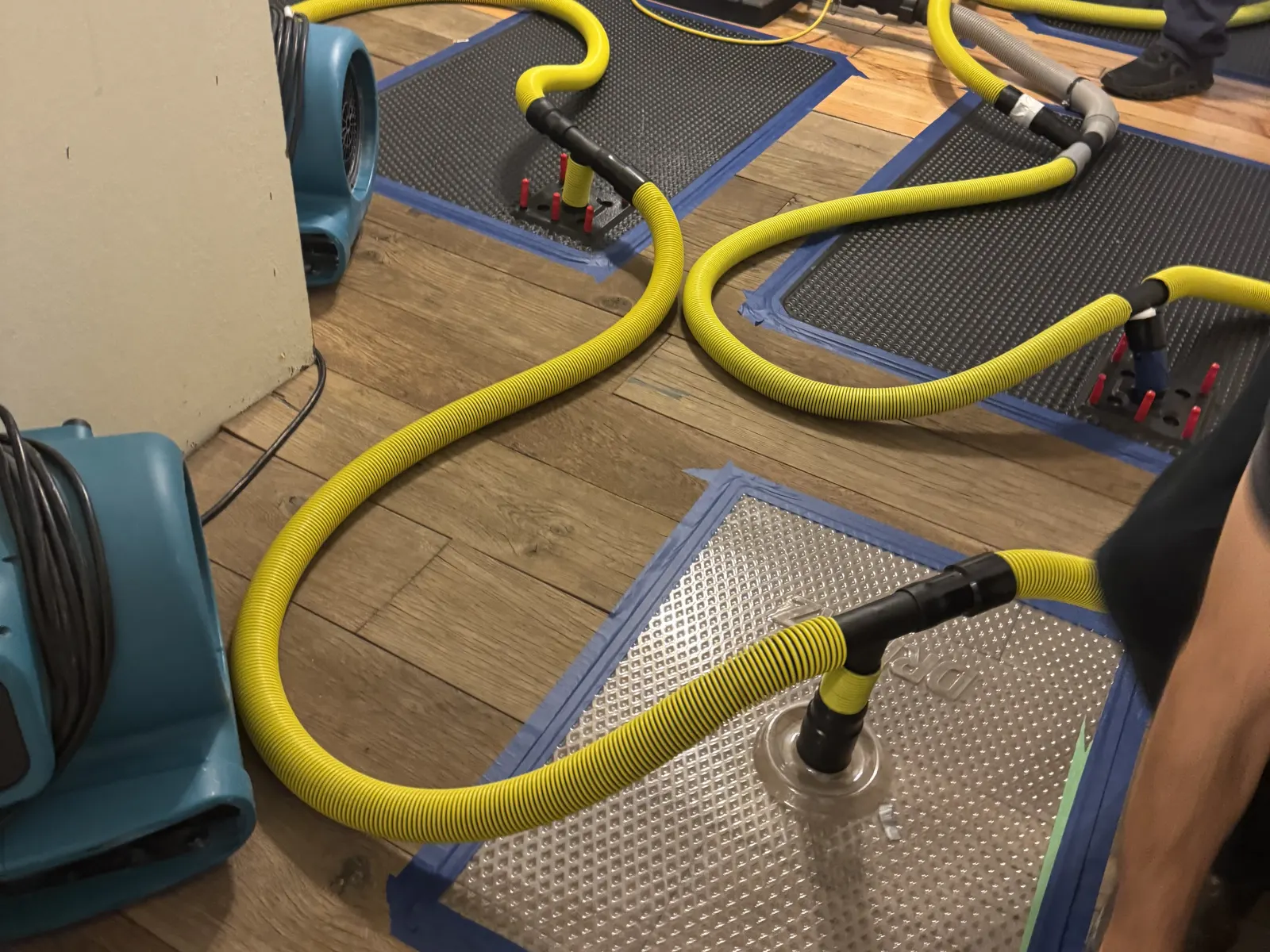
We map where the moisture is, remove flooring and materials that trap water against the slab, then run dehumidifiers and air movers until moisture meter readings reach a dry goal. Concrete releases water slowly, so slabs take longer than drywall.
Moisture mapping first
A moisture meter, a handheld tool that reads how much water a material holds, shows us how far the water has travelled across the slab and up the walls. We take readings from unaffected areas of the same materials in your home to set the drying goal, the number each wet material has to reach before we call it dry. That approach follows the IICRC S500 standard for water damage restoration.
Opening up what holds the water in
Vinyl plank, laminate and carpet pad hold moisture against the concrete, so they usually come up. Baseboard comes off, and wet drywall is cut above the water line so the wall cavity can breathe. Tile over a slab can often stay; the question is whether moisture is trapped beneath it, which we check before deciding.
The equipment
We use a low-grain refrigerant (LGR) dehumidifier, a dehumidifier built to keep pulling water out of air that is already fairly dry, with air movers that push dry air across the slab and wall surfaces. Equipment placement and daily readings go into a drying log. Our structural drying page explains the process and the log in detail.
Can a slab leak cause mold under flooring or in walls?
Yes. A slab leak can run unnoticed for a long time, and the US EPA advises drying water-damaged areas within 24 to 48 hours to prevent mold growth. Mold often starts under flooring, behind baseboard and at the bottom of drywall.
Because the water comes from below, the wettest materials are often hidden: the back of the baseboard, the tack strip under carpet, the bottom plate of the wall framing and the underside of flooring. When we open these up and find growth, we contain the area and remove it following the IICRC S520 standard as part of our mold remediation service. Independent third-party mold clearance testing is available when you, your carrier or the scope calls for it.
Mold can affect some people's health, and the CDC mold guidance covers who is most at risk. Please discuss any health concerns with a healthcare professional.
How long does slab leak water damage restoration take?
Typically longer than an upstairs leak. Drywall and framing commonly dry in three to five days, the slab takes longer, and a single-room rebuild often runs about one to two weeks. Readings set the pace, not the calendar.
| Stage | Who | Typical time |
|---|---|---|
| Finding and repairing or rerouting the pipe | Plumber | Set by the plumber's method and schedule |
| Moisture mapping, extraction and removal | PCH | Starts on the first visit |
| Drying drywall and framing | PCH | Three to five days is typical |
| Drying the slab | PCH | Longer; equipment stays until readings reach the goal |
| Rebuild of one room | PCH | Often about one to two weeks, including cure times |
Several rooms of flooring, kitchen cabinets that sit over the wet area, or mold found during removal all add time. We give you a written plan after the first inspection and update it as the readings change.
How much does slab leak water damage cost to repair?
It depends on how long the leak ran, how far the water spread, the flooring and cabinets involved, whether mold is found and how much needs rebuilding. We give a written estimate after inspecting and taking moisture readings.
Two slab leaks in similar houses can cost very different amounts. A leak caught early under tile in a hallway is a small drying job. A leak that ran for weeks under laminate across an open-plan living area, with cabinets on top, is a larger removal, drying and rebuild. The plumber's repair is a separate cost from the restoration. Our page on the water damage restoration process and cost explains how pricing is built.
Does homeowners insurance pay for a slab leak?
Coverage depends on your policy and your carrier's determination. Carriers commonly look at whether the damage was sudden and accidental or came from a gradual leak over time, and they may treat the pipe repair, access to the pipe and the water damage separately.
Ask your carrier about each of those three parts by name. We do not interpret policies or tell you what will be paid. What we do is document the loss from the first visit: moisture readings by room, photographs before anything is removed, a list of what was removed and why, and the daily drying log. You can share that record with your adjuster. The California Department of Insurance publishes a residential property claims guide that explains the claims process.
What does the rebuild after a slab leak involve?
Once the readings confirm dry, we replace what was removed: drywall, texture and paint, baseboard, flooring and any cabinets or vanities that came out. PCH is a California licensed general contractor, so the rebuild stays with the team that dried the home.
Matching existing finishes is often the hardest part. Flooring that runs continuously through several rooms may need more replacement than the wet area alone, and older wall textures take care to blend. We walk you through those choices before work starts. Our reconstruction and build-back page covers permits, finish matching and scheduling.
PCH Restoration Team is an IICRC Certified Firm and has served Orange County since 2009. The team you call is the team that does the work.
What if the slab leak is in a condo or HOA home?
In a condo or townhome, water from a slab leak can travel under shared walls into the next unit. Tell your property manager straight away, because the association and your neighbours may need to be involved.
We meter both sides of shared walls, keep separate readings and photographs for each affected unit, and report to the owner, the manager and the board as needed. Who repairs which part and which policy responds is set by your CC&Rs and decided by your board; ask your manager or an attorney. Our page on HOA and condo water damage explains how we work in shared buildings.
Slab Leak Questions
Should I shut off the water if I think I have a slab leak?
Yes. Turn off the main shut-off valve to stop more water reaching the slab, then call a plumber to confirm and repair the leak. If water is near outlets, cords or the electrical panel, keep clear and call 911. Call PCH at 949-617-1111, 24/7, to start drying.
Can I stay in my home while the slab is drying?
Usually, yes. Most slab leaks affect part of the home, and families live around the equipment, which is noisy and runs day and night. Moving out is worth considering when the kitchen or only bathroom is out of use, or when someone in the household has a health condition.
Will my tile or hardwood floor have to come up?
Often not the whole floor. Tile over a slab can often stay if no moisture is trapped beneath it. Solid hardwood can sometimes be dried in place. Laminate, vinyl plank and carpet pad usually come up because they trap water against the concrete. Moisture readings decide each room.
What should I photograph before the flooring comes up?
Photograph every affected room wide and close, including stains, lifted flooring, swollen baseboard and the water meter reading. Keep the plumber's invoice and any leak detection report. We photograph and record readings before removing anything, and that record is yours to share with your adjuster.
Do you work with any plumber, or do I need a specific one?
We work alongside the plumber you or your carrier chooses. We share what our moisture mapping shows about where the water spread, and we plan removal and drying around their repair or reroute. The plumbing repair itself stays with the plumber; drying, mold work and rebuild stay with us.
Water or Mold Damage Right Now?
The team you call is the team that does the work: drying, mold remediation and licensed rebuild.