
Water Damage Restoration Services in Orange County
PCH Restoration Team handles full-scope water damage restoration across Orange County — 24/7 water extraction, meter-verified structural drying, claim documentation, and licensed rebuild from a single company. We're a CSLB-licensed general contractor (#935386), family-run since 2009 and dispatched from our own yard in Laguna Hills, so the crew that dries your property is the crew that puts it back together. In Laguna Hills itself? Start with our water damage restoration in Laguna Hills page.
- Licensed CA Contractor — CSLB #935386
- Dry-Out + Rebuild, One Team
- Daily Documented Drying Logs
- HOA & Condo Specialists
Full-Scope Water Damage Restoration for Orange County Properties
Water damage restoration is the full process of returning a wet property to its pre-loss condition: stopping the source, extracting standing water, drying the structure to a verified moisture target, removing what can't be saved, and rebuilding what was removed. It is not the same as water cleanup. Cleanup handles what you can see; restoration handles what the water did inside your walls, under your flooring, and above your ceilings.
One local call. Dispatch across every Laguna Hills neighborhood — Nellie Gail Ranch, Moulton Ranch, North Laguna Hills and the condo tracts off Moulton and Paseo de Valencia — a person answers, not a national queue.
Mitigation and rebuild together under CSLB #935386, so there's no second contractor to hire once your property is dry.
The clock is real. The US EPA advises drying water-damaged materials within 24–48 hours; past that window, mold growth becomes likely.
The most common claim there is. Water damage and freezing made up 27.6% of homeowners insurance claims in 2022, averaging $13,954 paid (Insurance Information Institute).
Why speed changes the size of the job
Water moves faster than most homeowners expect, and it moves in directions that aren't obvious. Drywall wicks moisture upward against gravity, so a floor-level spill routinely leaves a wet band a foot or more up the wall. Water tracks along the underside of subfloor and follows framing into rooms that never got touched. Laminate swells at the seams and delaminates; engineered wood cups; carpet pad holds water like a sponge long after the carpet surface feels dry.
That's why the gap between a same-day call and a next-week call is usually the gap between a two-room dry-out and a remediation project with containment, testing and a much larger rebuild. The EPA's guidance is blunt about it: dry the materials inside 24 to 48 hours and in most cases mold won't grow. Miss that window and you're no longer managing water — you're managing biology.
What each phase of a PCH job includes
One contract covers all three phases below. You get a named point of contact from the first call through the last coat of paint.
| Phase | What we do | What you get | Typical timing |
|---|---|---|---|
| 1. Emergency response & extraction | Source control, electrical and contamination safety check, moisture mapping with meters and thermal imaging, then standing-water extraction. | A written scope of the affected area, cause-of-loss photos, and an initial moisture map. | Same day |
| 2. Structural drying & monitoring | Controlled removal of anything that can't be dried safely, then dehumidifiers and air movers set to a written drying plan with daily readings. | Daily moisture logs, equipment placement records, and a final verification reading before equipment leaves. | 3–5 days typical |
| 3. Repairs & rebuild | Drywall, texture, paint, baseboard, flooring and cabinetry under our own general contractor license. | A single itemized rebuild scope and one point of contact through completion. | Scope-dependent |
Included in the restoration scope
- On-site assessment and moisture mapping, including inside wall cavities and under flooring
- Water extraction and controlled demolition of unsalvageable materials
- Drying equipment, placement, daily monitoring and final verification
- Anti-microbial application where the water category calls for it
- Photo documentation and drying logs formatted for your adjuster
- Reconstruction back to pre-loss condition under CSLB #935386
Quoted separately — and we'll say so upfront
- Mold remediation — always paired with independent third-party testing, never self-certified by us
- Contents pack-out and storage, which we subcontract to a specialist
- Plumbing repair of the failed pipe, fixture or appliance itself
- Upgrades you choose during the rebuild that go beyond pre-loss condition

Emergency First Steps Before Our Crew Arrives
Handle electricity first, then stop the water, then photograph everything before you move it, then call. In that order. Those four steps protect your safety and your insurance claim while a crew is on the way, and they take about ten minutes.
- Deal with the electricity. If water is anywhere near outlets, a panel, or a submerged appliance, don't walk into it. Shut the breaker off from a dry spot, or leave the area entirely and let us handle it on arrival. No amount of flooring is worth a shock risk.
- Shut off the water. Use the fixture's angle stop if the leak is local — under a sink, behind a toilet, at the washing machine. If you can't isolate it, use the main shutoff on the street side of the house. Don't know where yours is? Tell us on the phone and we'll walk you to it.
- Photograph before you move anything. Wide shots of each affected room, then close-ups of the source and the wet materials. Adjusters ask for pre-cleanup photos constantly, and the moment you mop or move furniture, that evidence is gone for good.
- Call 949-617-1111. Tell us what failed, roughly how much water, and whether it's still flowing. That single answer determines what equipment goes on the truck before the crew leaves the yard.
What not to do while you wait
- Don't run the HVAC if water reached ducting or return vents. You'll distribute moisture and, in a contaminated loss, spores into rooms that were fine.
- Don't pull up wet carpet or baseboard yourself. It spreads contamination, damages material that could have been saved, and makes the scope harder to document.
- Don't use a household shop vac on anything but clean water. Gray and black water need equipment that can be decontaminated afterward.
- Don't throw anything away. Damaged contents are part of your claim. Photograph them and set them aside instead.
- Don't wait for your insurer to authorize mitigation. Most policies require you to prevent further damage. Stopping the loss is your responsibility, and it happens before any adjuster arrives.
Our Six-Stage Water Damage Restoration Process
Six stages, in a fixed order: dispatch, source control and inspection, extraction, controlled demolition where it's genuinely needed, structural drying with daily verification, then reconstruction. Stages one through three usually happen on the first day. Drying runs three to five days. Rebuild follows once the readings confirm the structure is dry.
Emergency Contact & Dispatch
Call 949-617-1111. We ask what happened, where the water is, and whether it's still flowing, then route the nearest available crew with the right equipment already loaded.
24/7Source Control & Inspection
We stop the water at its source, then map how far it traveled using pin and pinless moisture meters plus thermal imaging — including inside walls and under floors.
On arrivalWater Extraction
Standing water comes out with truck-mounted and portable extraction units. Every gallon removed mechanically is a gallon the dehumidifiers don't have to pull out of the air.
Same dayControlled Demolition
Only where needed. Saturated materials that can't be dried safely come out in straight, documented cuts, with unaffected areas protected — because we're the team that rebuilds them.
As neededStructural Drying & Monitoring
Dehumidifiers and air movers run to a written drying plan. A technician returns daily to take readings, reposition equipment, and log progress until the goal is met.
3–5 days typicalReconstruction
Drywall, texture, paint, baseboards, flooring and cabinetry — rebuilt under California contractor license #935386 so the loss stops being visible.
Final phase
Restoration timeline — how long each stage takes
Extraction is same-day. Structural drying typically runs three to five days, though a Class 4 loss into hardwood, plaster or concrete can run longer because those materials release moisture slowly. Reconstruction depends entirely on scope: drywall and paint can be days, while matched flooring and cabinetry can take weeks once materials are ordered. Here's what a typical residential dry-out looks like day to day.
Stop, extract, set up
Source control, safety check, moisture mapping, extraction, any necessary demolition, and equipment placed. Baseline readings are recorded.
First real data
Readings usually show the steepest drop. Equipment gets repositioned toward whatever is drying slowest — often an interior wall cavity or a subfloor.
The long tail
Surfaces feel dry to you while the meters still don't agree. This is the phase most DIY attempts quit on, and it's where the mold risk actually lives.
Verify and pull
Affected materials match the drying goal, a final verification reading is taken and logged, equipment comes out, and the rebuild scope is confirmed.
The equipment on a typical job — and what each piece is for
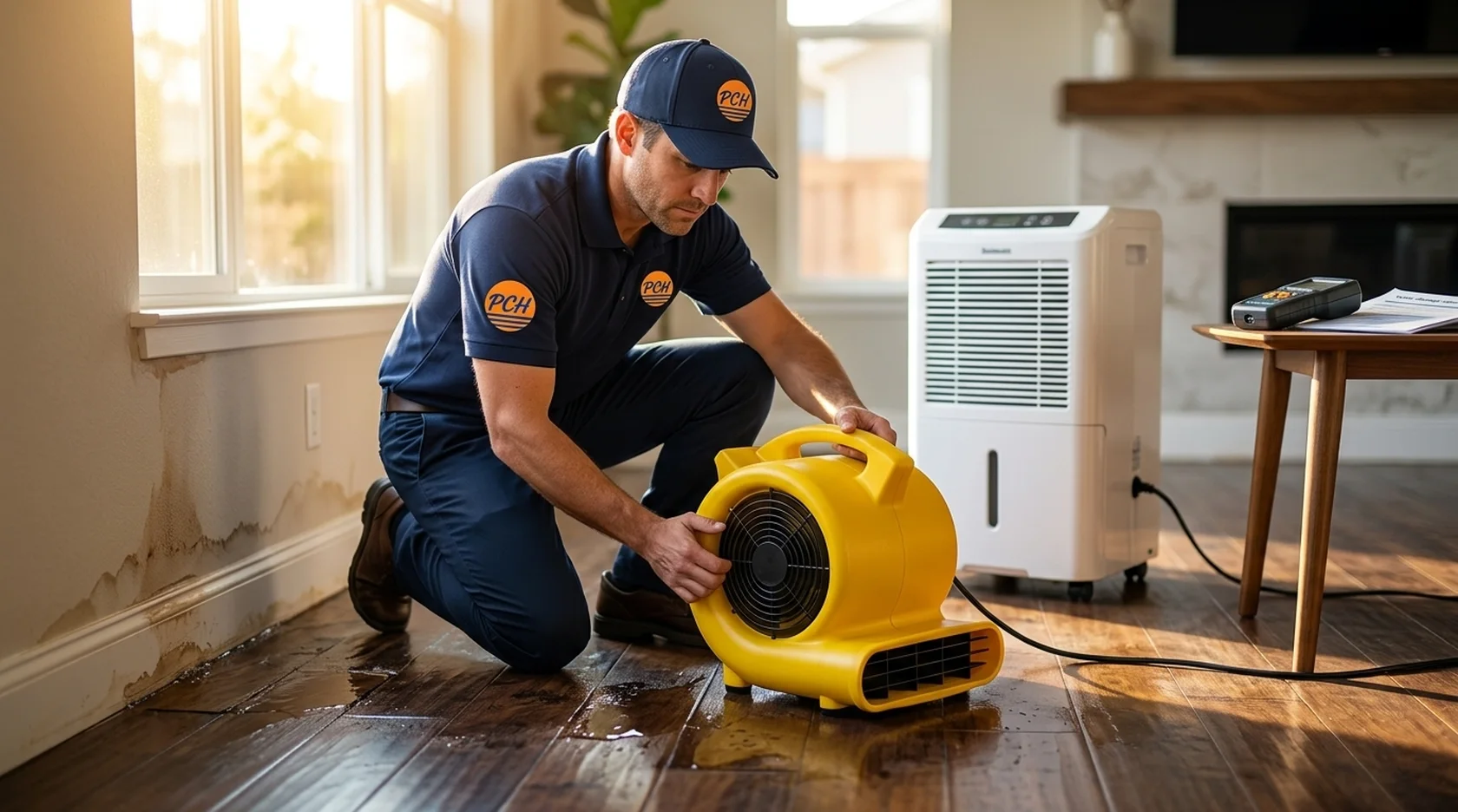
Restoration equipment isn't interchangeable, and knowing what's on your job helps you tell a real drying plan from a couple of fans left in a hallway.

Extraction units
Truck-mounted and portable extractors pull free water out mechanically. Removing water this way is far faster and cheaper than evaporating it.

Air movers
Axial and centrifugal units push high-velocity air across wet surfaces to accelerate evaporation. Placement angle matters more than quantity.

LGR dehumidifiers
Low-grain refrigerant units pull the evaporated moisture back out of the air. Without them, air movers just move wet air around the room.

Moisture meters
Pin meters read moisture content inside material; pinless meters scan without damage. Together they're how the drying goal gets verified.

Thermal imaging
Infrared cameras reveal temperature differences caused by evaporative cooling, showing where water traveled behind finishes before anything is opened up.

Air scrubbers & containment
HEPA air scrubbers and negative-air containment are used on contaminated losses to keep the affected zone from becoming the whole house.
Water Categories & Classes: Clean, Gray and Black Water Losses
Under the ANSI/IICRC S500 standard, water is classified by how contaminated it is: Category 1 is clean, Category 2 is meaningfully contaminated, Category 3 is grossly contaminated. The category decides whether wet materials get dried in place or removed and replaced — which is the single biggest driver of what your restoration costs.
| Category | Typical sources | Health risk | What happens to wet materials |
|---|---|---|---|
| Category 1 Clean water | Supply lines, angle stops, water heaters, an overflowing tub or sink with nothing added. | Low at the moment of release. | Most materials can be dried in place. Smallest tear-out and the shortest timeline. |
| Category 2 Gray water | Washing machine and dishwasher discharge, toilet overflow without solids, aquarium or waterbed failures. | Can cause illness through contact or ingestion. | Porous materials like carpet pad and saturated drywall usually come out. Anti-microbial treatment is standard. |
| Category 3 Black water | Sewage backups, groundwater intrusion, or Category 1 or 2 water left standing long enough to degrade. | Grossly contaminated — may carry pathogens. | Contaminated porous materials are removed and replaced rather than dried. Containment and HEPA filtration required. |
Category definitions per the IICRC S500 Standard for Professional Water Damage Restoration. There is no "Category 4" — categories run 1 to 3; the separate class system runs 1 to 4.
Categories escalate with time — that's the part people miss
A category isn't fixed at the moment of the leak. Clean water sitting on carpet in a warm house doesn't stay clean. As it picks up soil, dyes, adhesives and whatever was on the floor, and as microbial growth starts, Category 1 becomes Category 2 and Category 2 becomes Category 3. That escalation is the mechanism behind the 24–48 hour rule the EPA publishes, and it's why a burst pipe found Friday afternoon and the same burst pipe found Monday morning are billed as fundamentally different jobs.
The four classes — how hard it is to dry
Category describes contamination. Class describes drying difficulty, and any category can pair with any class.
- Class 1. The smallest scope — minimal absorption, water limited to part of one room, mostly low-porosity materials. The fastest dry-out.
- Class 2. An entire room affected, with water wicked up walls under two feet and into carpet and pad.
- Class 3. Water came from overhead — a second-floor line or a ceiling failure — so ceilings, walls, insulation and flooring are all saturated.
- Class 4. Specialty drying. Water is bound inside low-permeability materials like hardwood, plaster, concrete or stone, which release it slowly and often need longer run times and different equipment.
When someone quotes you a flat "three-day dry-out" before anyone has taken a reading, this is the distinction they're skipping. A Class 4 hardwood loss and a Class 1 tile loss are not the same job at any price.
Structural Drying With Verified Moisture Documentation
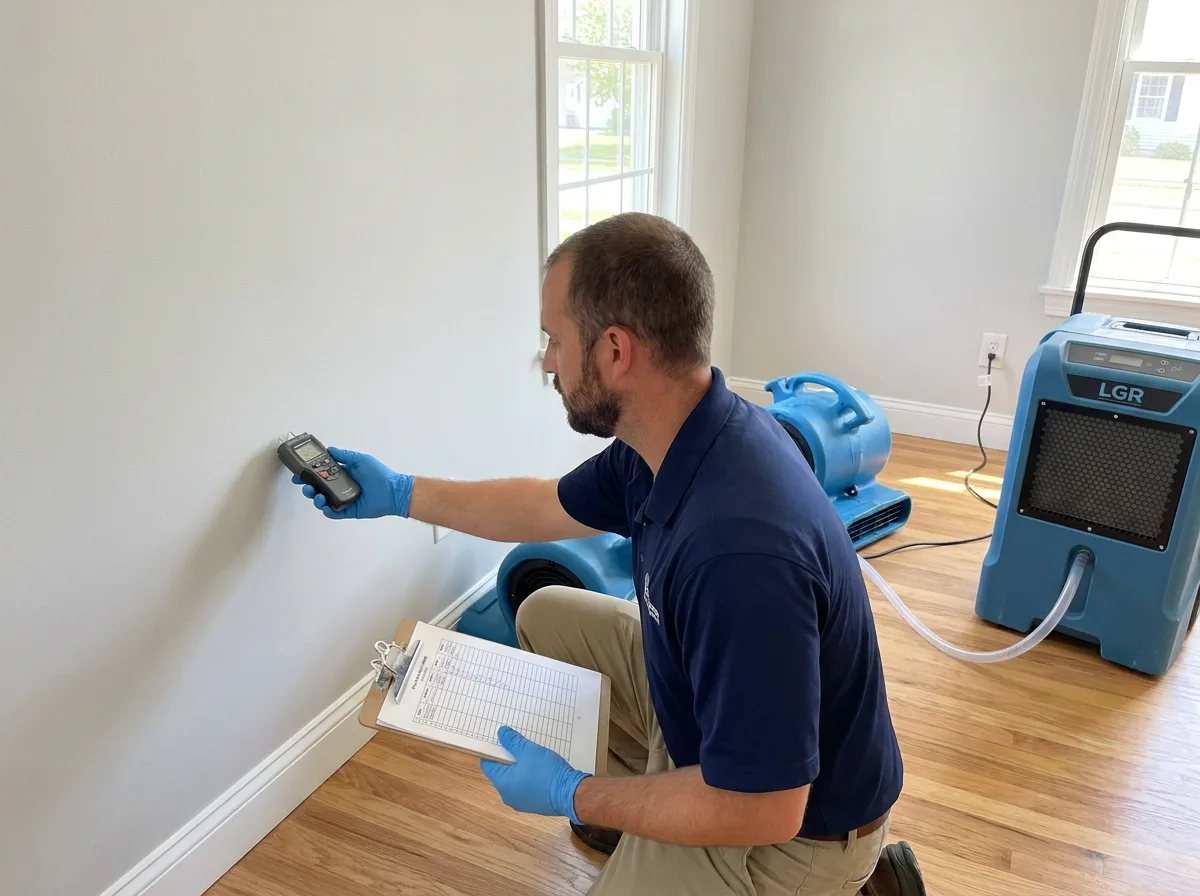
Dry isn't a judgment call made by touch — it's a number we have to hit and prove. Before drying starts, our crew takes moisture readings from unaffected material of the same type elsewhere in the property. That reading becomes the drying goal. Equipment stays until the wet materials match it, which is the methodology the IICRC S500 standard is built around.
This is the part most homeowners never get shown, and it's the part that separates a finished job from a job that smells musty in six weeks. A hardwood floor that feels dry underfoot can still hold enough moisture in the subfloor beneath it to support growth. A wall that looks perfectly fine can be wet eighteen inches up inside the cavity where the drywall wicked it. Surface appearance tells you almost nothing about what's happening inside the assembly.
The documentation you receive
Initial moisture map
Where the water actually reached, room by room, including the readings you can't see with your eyes. This defines the scope everything else is measured against.
Daily drying log
Readings taken each day of the dry-out, so progress is a trend line rather than an opinion. If a material stalls, the log shows it and the plan changes.
Equipment record
What was placed, where, and for how long. This is the line item adjusters scrutinize most closely, and having it documented is how you avoid a fight over it.
Final verification
The closing reading showing affected materials met the drying goal before equipment came out — your proof the structure was actually dried, not just visited.
"We don't tear out hardwood before we've taken a reading. A lot of what people are told to replace can be dried — and every extra square foot we cut is work we have to put back."
— Jarrod Kasser, owner, PCH Restoration Team
Water Damage Restoration Cost in Orange County
Nationally, water damage restoration averages about $3,860, with most jobs landing between roughly $1,383 and $6,370 (HomeGuide, 2026). Those figures cover mitigation and drying only, not reconstruction. The single biggest driver is the water category, because contaminated water means materials get removed and replaced instead of dried in place.
| Water category | National cost per sq ft | Why it costs what it does |
|---|---|---|
| Category 1 Clean | $3–$4 | Drying in place, minimal demolition, no containment, shortest equipment run time. |
| Category 2 Gray | $4–$6.50 | Carpet pad and saturated drywall come out, anti-microbial treatment is added, disposal costs appear. |
| Category 3 Black | $7–$7.50+ | Removal and replacement rather than drying, plus containment, HEPA filtration, PPE and regulated disposal. |
Per-square-foot ranges: HomeGuide, 2026. Category definitions: IICRC S500. These are US averages for mitigation, published here so you can sanity-check any estimate you receive — they are not a PCH quote. Your written scope comes after an on-site assessment.
Six things that move your number
Water category
The same square footage costs roughly twice as much to handle as Category 3 as it does as Category 1, because the work changes from drying to demolition and replacement.
How far it traveled
Water follows framing and gravity. A second-floor supply line routinely affects two rooms upstairs, the ceiling below, and the wall cavity in between.
What it soaked
Tile and vinyl over slab dry fast and cheap. Engineered wood, carpet pad, plaster and cabinetry toe-kicks are slow, expensive, or simply unsalvageable.
How long it sat
A leak found within the hour and a leak found on Monday after a weekend away are different categories, different classes, and different invoices.
Whether mold is involved
Visible growth adds containment, remediation, and independent third-party clearance testing on top of the drying scope.
Rebuild scope
Drywall and paint is a modest line item. Matched flooring, custom cabinetry and stone are not, and lead times on materials can outlast the drying by weeks.
How to read a restoration estimate without getting taken
Restoration estimates are usually written in the same industry estimating software adjusters use, which makes them dense and easy to hide things in. Three checks catch most problems. First, look for equipment line items with quantities and days — that should match the equipment record you were given, not a round number. Second, look at demolition square footage and ask what reading justified each area. Third, check whether mitigation and reconstruction are priced separately and by whom; if the dry-out is cheap but the rebuild is vague, the number you were quoted isn't the number you'll pay.
When you probably don't need to call us
We'd rather tell you the truth than sell you a dry-out. A small clean-water spill on tile, sealed concrete or vinyl — under roughly 10 square feet, caught within the hour, with nothing porous involved — can usually be handled with towels and a fan, provided everything is genuinely dry within 24 to 48 hours per EPA guidance.
The EPA also notes that mold covering less than about 10 square feet can often be cleaned by a homeowner. Below those thresholds, calling a restoration company is frequently overkill, and any company that tells you otherwise is selling.
Call a professional when any of these are true: the water is gray or black, it reached drywall, carpet pad, insulation or subfloor, it sat overnight, it came through a ceiling, it involves a shared wall in a condo, or you can smell it. Those are the situations where waiting turns a drying job into a remediation job — and the cost difference is not small.
Insurance Coverage, Claim Documentation & Adjuster Coordination
Whether your homeowners policy pays usually comes down to one question: was the failure sudden and accidental, or gradual? Sudden events are commonly covered. Slow, long-running leaks and flood water commonly are not. Every policy differs and we won't tell you what your carrier will approve — but we will document the loss so the decision gets made on facts rather than guesswork.
| Typically covered | Typically not covered |
|---|---|
| A burst or suddenly failed supply line | Gradual seepage from a leak that ran for weeks or months |
| A water heater or appliance hose that lets go | Damage attributed to deferred maintenance |
| Sudden storm damage that opens the roof | Rising water and flood — that needs a separate NFIP flood policy |
| Resulting damage to drywall, flooring and contents | Repair of the failed pipe or appliance itself, in many policies |
| Tear-out needed to access a slab leak, under many policies | The slab leak pipe repair itself, under many of those same policies |
General guidance only — coverage is set by your specific policy, endorsements and state. Check with your carrier or agent before assuming either column applies to you.
Why water claims get scrutinized more than most
Because they're the most common claim there is. According to the Insurance Information Institute, water damage and freezing accounted for 27.6% of homeowners insurance claims in 2022, with an average paid claim of $13,954 across the 2018–2022 period. Roughly one in sixty insured homes files one in any given year. Carriers have seen every version of this loss, which is why documentation quality changes outcomes more than argument does.
What we document, from the first hour
- Cause-of-loss photography. The failed component and the surrounding condition, captured before anything is disturbed.
- Moisture mapping. A room-by-room record of affected area, which is what justifies the scope of both demolition and drying.
- Daily drying logs. Readings and equipment placement across the full dry-out, so run time is evidenced rather than asserted.
- Itemized scope of work. Written in the estimating format adjusters expect, so it can be reviewed line by line instead of renegotiated wholesale.
- Adjuster coordination. We speak to your adjuster directly, so you're not acting as courier between two companies during the worst week of your year.
Homes, Condos, HOAs, Rentals & Commercial Property We Restore
We restore all four property types across Laguna Hills — single-family and estate homes, stacked condos and townhomes, rental apartment communities, and the offices, medical suites and retail along El Toro Road and Paseo de Valencia. They're genuinely different jobs. The drying science doesn't change between a detached house and a stacked condo. What changes is who owns which part of the building, who carries which policy, and who has to sign off before work starts.
Single-family homes
Slab leaks, supply-line failures, water heaters and roof leaks across the Laguna Hills tracts — the original Moulton Ranch streets off El Toro Road and Paseo de Valencia especially, where the plumbing is now decades old. Full residential water damage service through rebuild.
Condos & HOA communities
A shared-wall loss involves at least three parties and often two carriers. We document scope and origin precisely enough for the owner, the neighbor, the board and the manager to work from one file.
Commercial & multi-tenant
Offices, retail and multi-tenant buildings where downtime is the real cost. Commercial water damage work is sequenced around occupancy and phased so you can keep operating where possible.
Rentals & managed property
Tenant coordination, per-unit documentation, and an invoice and scope package a remote owner or property manager can hand straight to their carrier without translating it first.
Who's responsible in a California condo — the §4775 question
This is the question we field most often from Laguna Hills owners and boards — and in a city where the great majority of homes sit inside a master association, it's the one that stalls the most jobs. Under California Civil Code §4775, the association is generally responsible for repairing and maintaining the common area, while the owner is generally responsible for the separate interest — with exclusive-use common area typically falling to the owner for maintenance. The critical caveat is that a community's CC&Rs can shift those lines, and many do.
In practice, that means the fastest way to a stalled claim is an undocumented origin. If nobody can prove whether the water came from a common-area line inside a wall or from the owner's fixture, two carriers will point at each other for weeks while the building stays wet. We've worked association water losses in Laguna Hills communities for over a decade — Nellie Gail Ranch, Moulton Ranch, North Laguna Hills and the condo tracts off Moulton Parkway — and the single most valuable thing we bring to a condo job isn't equipment — it's an origin and scope record clear enough that the responsibility question answers itself.
Common Causes of Water Damage in Orange County Homes
Slab leaks lead, and it comes down to housing stock. Laguna Hills was subdivided from the Moulton Ranch in the early 1960s and built out through the 1980s, almost entirely slab-on-grade with copper supply lines — exactly the construction that produces slab leaks once the plumbing reaches middle age. After that: supply-line failures, water heaters, roof leaks, shower pans and HVAC condensate.
Slab leaks — the signature Laguna Hills loss
Hot-water lines running under a concrete slab are the failure we see most. The tells are specific: a warm spot on the floor, a water bill that jumped with no change in habits, the sound of running water with every fixture off, or flooring that starts lifting or cupping in one area. Because the leak is under concrete, the water often travels a considerable distance through the sub-slab before it surfaces — which is why the wet spot in the hallway frequently isn't above the actual break.
The older tracts are where we see them cluster: Nellie Gail Ranch, Moulton Ranch and North Laguna Hills, where original copper is now decades into hard water, soil movement and thermal cycling. Newer neighborhoods aren't immune, but the failure pattern there tends to be fittings and fixtures rather than the lines themselves.
The other five causes, in the order we see them
Supply lines & angle stops
Toilet, washing machine and under-sink connectors fail without warning and flood at full line pressure until someone finds the shutoff. Braided stainless lines have a service life; the plastic-nut versions have a shorter one.
Water heater failures
Tanks corrode from the inside and let go all at once, usually into a garage or a closet backing onto living space. A unit past ten years old sitting on finished flooring without a pan is the classic setup.
Roof leaks & wind-driven rain
Winter storms push water into roof edges, flashing and stucco penetrations — a recurring issue for Laguna Hills' tile-roofed association buildings, where one bad detail repeats across dozens of identical units in the same tract. See roof leak water damage.
Shower pans & tile failures
Slow failures that soak subfloor and adjacent walls for months. These almost never announce themselves as a puddle — they announce themselves as a musty smell, a soft spot, or staining on the ceiling below.
HVAC condensate lines
A clogged condensate line overflows into ceilings and hall closets. Usually discovered as a stain, and usually after it has been wet long enough to matter.
"The damage that gets expensive is almost never the flood you watched happen. It's the one that was quietly wet behind a wall for a month before anyone noticed the smell."
— Jarrod Kasser, owner, PCH Restoration Team
The warning signs worth acting on
Most of the large jobs we run started as something small that somebody reasonably decided to watch for a while. If you notice any of these, it's worth a look before it becomes a remediation:
- A musty smell you can't source
- A warm patch of floor
- Bubbling or separating baseboard
- A stain that returns after painting
- Flooring that cups or lifts
- A water bill that stepped up and stayed
- Paint blistering low on a wall
- Running water with every fixture off
An inspection is a fraction of the cost of a containment job.
How the Laguna Hills Climate and Rain Season Shape Water Damage Risk
Laguna Hills gets roughly 13–14 inches of rain a year, and about three-quarters of it falls between December and March. February is the wettest month at around 3.6 inches; July averages almost nothing. That shape is exactly why water damage here catches people off guard — the city stays dry for eight or nine months, every roof and stucco detail goes untested, then a handful of winter storms deliver most of the year's rain at once.
Total annual rainfall. Less than a third of the US average — Laguna Hills is semi-arid, which is precisely why its buildings are not conditioned for sustained water.
Falls Dec–Mar. The wet season is compressed into four months, so the failures cluster into a handful of storm days rather than spreading across the year.
February, the peak. Our single busiest stretch for roof, flashing and stucco intrusion calls across the city.
Effectively dry months. Long enough for sealants to shrink and crack unnoticed before the first real storm tests them.
Why it matters: a saturated wall in a Nellie Gail or Moulton Ranch home will not dry on its own during a wet week in January — the outside air the house is breathing is already near saturation. Waiting it out is how a two-day extraction becomes a containment job. Figures are long-term monthly averages; totals vary by station and reference period.
The four seasonal drivers we plan around
Fall — Santa Ana winds
Hot, bone-dry offshore winds through autumn accelerate exactly the shrinkage and cracking in sealants, flashing and stucco that the winter rain then exploits. The damage is done in October; the leak shows up in January.
Late spring — the marine layer
The "June gloom" overcast pushes overnight humidity up for weeks. It floods nothing, but it slows natural drying and keeps a small unaddressed leak in the range mold likes. This is when slow shower-pan and HVAC-condensate failures turn into mold calls.
Year-round — irrigation
Laguna Hills landscaping is heavily irrigated by design, keeping the subgrade under slab-on-grade foundations damp even through a rainless August. With expansive soils that move seasonally, that's steady mechanical stress on the under-slab copper this city is built on.
Any month — indoor causes
Supply lines, angle stops, water heaters and appliance hoses fail on their own schedule, weather or not. Roughly speaking: winter brings us the storm jobs, and the rest of the year brings us the plumbing jobs.
Laguna Hills drainage — hillside runoff, not river flooding
Laguna Hills sits in the Aliso Creek watershed — roughly 36 square miles draining out of the Santa Ana Mountain foothills, through seven Orange County cities, and into the ocean at Aliso Beach. Through the developed stretches the creek is a managed channel, so routine rainfall is handled without much drama. The city sits in the Saddleback Valley at about 364 feet, which means the storm risk here is hillside runoff hitting properties on the slopes, not river-style flooding.
- Aliso Creek
- Sulphur Creek
- English Canyon Channel
- Saddleback Valley hillside runoff
- Managed flood-control channels
Why Orange County Property Owners Choose PCH Over a Franchise
Most restoration companies only do half the job. A dry-out crew extracts and dries, then hands you a list of contractors. A franchise arrives from a regional dispatch center with a standardized scope. We're a licensed general contractor that also does mitigation — which changes the incentives on your specific job.

| Decision factors Questions worth asking | Hometown choice PCH Restoration TeamLicensed local GC | 02Typical National FranchiseTerritory-based | 03Typical Independent Mitigation Co.Cleanup only | 04Handyman / UnlicensedNo license |
|---|---|---|---|---|
| Availability & dispatch | 24/7 live dispatch — nearest crew routed | Call-center routing | Varies | Business hours |
| Who rebuilds after the dry-out? | Same team — licensed GC, CSLB #935386 | Often subcontracted | Hands you off to a contractor | Not licensed for it |
| Incentive on demolition | Every cut is work we owe back at a fixed price | Varies | Tear-out is billable; someone else reinstalls | Unmeasured — no reading taken |
| Drying verification | Daily documented drying logs, handed to you | Varies by franchisee | Varies | Rarely |
| Mold clearance testing | Independent third-party lab, always | Varies | Sometimes self-tested | Not offered |
| Insurance claim support | Full documentation & adjuster coordination | Yes | Varies | No |
| HOA & condo experience | 10+ years, board-ready scopes | Varies by location | Varies | Not listed |
The demolition incentive, stated plainly
This is the part of the industry nobody likes to say out loud. When the company that tears out your drywall isn't the company that has to reinstall it, tear-out is pure revenue with no downstream cost. When it's the same company, every extra square foot cut is labor and material owed back at a fixed price. We're not claiming better character — we're pointing at a structural difference in who carries the cost of over-demolition. Ask any contractor you're considering which side of that line they sit on.
Why we insist on third-party mold testing
If mold shows up on your job, the company doing the remediation should not be the company certifying that the remediation worked. We use independent third-party testing for clearance on every mold job, which means the verdict comes from someone with no financial interest in the answer. It occasionally costs us a return trip. It also means the clearance document is worth something to a future buyer, a board, or an adjuster.
Who We Restore For Across Orange County
Laguna Hills isn't one kind of customer. A flooded Nellie Gail Ranch home, a stacked condo off Moulton with three affected units, a rental apartment building, and a medical suite on Paseo de Valencia are four different jobs with four different decision-makers. Here's how we handle each, and what tends to matter most to you depending on which one you are.
Families in the tracts
Nellie Gail Ranch, Moulton Ranch, North Laguna Hills and the tracts off Paseo de Valencia. Usually a first-time loss, usually with kids or pets in the house, and the real question underneath is "is this going to make my family sick." We contain first, work around the rooms you're still living in where we safely can, and pair anything mold-related with independent third-party testing so the answer isn't just our opinion.
HOA boards & association managers
Most Laguna Hills homes sit inside a master association, so the responsibility line under Civil Code §4775 comes up on nearly every condo and townhome job. What you need from a restoration contractor is an origin-and-scope record clear enough that the owner-versus-association question answers itself — before two carriers spend a month pointing at each other.
Multifamily property managers
One upstairs supply failure routinely reaches three occupied units. We moisture-map every affected unit on day one — not just the one that called — and keep per-unit documentation separated so each file stands on its own. Occupied-building work means scheduling around residents and keeping corridors passable.
Out-of-area landlords
Laguna Hills has a deep rental market — Saddleback Valley professionals and families renting into the school district — and plenty of those owners live somewhere else. Your tenant found the water; you have to make decisions from a distance. We coordinate directly with the tenant, and you get the photos, daily moisture logs and scope record without needing to fly in.
Businesses & office tenants
Offices, medical suites and retail along El Toro Road, Paseo de Valencia and the Saddleback Memorial campus. Closed doors cost more than the repair does, so the priority is a work sequence that reopens the space fastest — overnight and weekend crews where the building allows it, salvage-first on inventory and equipment, and documentation your business-interruption claim will actually need.
Longtime owners in the original tracts
The original 1960s and 70s Moulton Ranch tracts off El Toro Road and Paseo de Valencia — Laguna Hills' earliest housing, where the original plumbing is now decades old and slab leaks cluster. Often a fixed income and a strong preference for understanding the job before agreeing to it. We'll walk the property with you, explain what each reading means, and put the scope in writing before anything gets opened up.
Where We Work: Our Laguna Hills Base and the Orange County We Cover
We cover all of Laguna Hills — Nellie Gail Ranch and Moulton Ranch on the east side, North Laguna Hills, and the condo and townhome tracts along El Toro Road and Paseo de Valencia — dispatched 24/7 from our own yard in the city, ZIP code 92653. From there we reach the whole Saddleback Valley and the wider Orange County service area.
Burst pipe, flood, or mold — day or night — a licensed local crew is already nearby.
Call 949-617-1111 — 24/7Laguna Hills — Nellie Gail & the ranch tracts HQ — primary
Laguna Hills — central & north El Toro Rd & Paseo de Valencia
Saddleback Valley neighbors Minutes from the yard
Irvine & the wider county Still our service area
Water in Your Property Right Now?
A real local person answers 24/7 and routes the nearest available crew to your Laguna Hills address.
Water Damage Restoration Questions, Answered
Pick a topic — or call 949-617-1111 and ask a real person, 24/7. Deep policy and licensing questions live on the full FAQ page.
How quickly should water damage be dealt with?
Immediately — the first 24 to 48 hours decide how big the project becomes. Drywall and flooring absorb water within hours, and the EPA advises drying water-damaged materials within 24–48 hours to prevent mold growth. Calling a professional team the same day usually means less demolition, faster drying, and a smaller claim.
How much does water damage restoration cost?
US averages run about $3,860, with most mitigation jobs between $1,383 and $6,370 (HomeGuide, 2026) — before reconstruction. Cost tracks the water category most closely: roughly $3–$4 per square foot for clean water, $4–$6.50 for gray, and $7 or more for contaminated Category 3 water where materials get replaced rather than dried. We give you a written scope after the on-site assessment, not a number over the phone.
How do I know my property is actually dry?
By a measured reading, not by touch. Before drying starts we take moisture readings from unaffected material of the same type and use that as the drying goal, which is the approach the IICRC S500 standard is built on. Equipment stays until affected materials match it, and you receive the daily logs plus the final verification reading. Any contractor who can't show you those numbers can't prove your structure was dried.
What's the difference between water Category 1, 2 and 3?
Category 1 is clean water from a sanitary source such as a supply line or water heater. Category 2 is gray water carrying meaningful contamination, like washing machine discharge or a toilet overflow without solids. Category 3 is grossly contaminated black water — sewage, groundwater, or clean water left standing long enough to degrade. The category decides whether wet materials are dried in place or removed and replaced, which is why it drives cost more than square footage does.
Can't I just dry it myself with fans?
Sometimes — a small clean-water spill on tile or vinyl, caught within the hour and fully dry inside 24–48 hours, is genuinely a towels-and-fan job. But household fans move air across surfaces and can't pull moisture out of wall cavities, sill plates or subfloors. Blowing air over a wet surface while the inside stays damp is how hidden mold problems start.
Do you remove walls and flooring on every job?
No. We remove only what can't be safely dried or is already compromised, and we document why. Because we're also the licensed contractor doing the rebuild, we have no incentive to over-demolish — every extra square foot we cut is work we have to put back cleanly.
How long does water damage restoration take from start to finish?
Emergency extraction happens the same day. Structural drying typically runs three to five days with daily monitoring, though Class 4 losses into hardwood, plaster or concrete take longer because those materials release moisture slowly. Reconstruction depends on scope — a drywall-and-paint repair may take days, while flooring and cabinetry replacement takes longer. We give you a written timeline after the initial assessment and update it as drying progresses.
Do you handle water damage in condos and HOA buildings?
Yes — it's one of our deepest specialties. Water in a shared-wall building nearly always involves more than one party: the unit owner, a neighbor, and the association. California Civil Code §4775 sets the general split between association and owner responsibility, but CC&Rs frequently modify it, so we document scope and origin clearly enough for boards, managers and multiple carriers to work from one file. We've handled Laguna Hills association water losses for over a decade — the city is almost entirely governed by master associations, so this is most of what we do.
Is water damage restoration covered by insurance?
Often, when the cause is sudden and accidental — but every policy differs, and gradual damage is commonly excluded, as is flood water, which requires a separate NFIP policy. Water damage and freezing accounted for 27.6% of homeowners claims in 2022 at an average of $13,954 paid (Insurance Information Institute), so carriers scrutinize them closely. We document everything from day one and work in the estimating formats adjusters expect. Call us before moving anything so the cause and extent are captured properly.
Do you work with my insurance adjuster directly?
Yes. We coordinate with your adjuster and provide the documentation package — cause-of-loss photos, moisture maps, daily drying logs, equipment records and an itemized scope — so you're not relaying messages between two companies. What we won't do is promise you an outcome. Approval is your carrier's decision, and any contractor who guarantees coverage is telling you something they can't know.
What areas do you cover for water damage restoration?
All of Laguna Hills, California — every neighborhood in ZIP code 92653, from Nellie Gail Ranch and Moulton Ranch through North Laguna Hills and the condo and townhome tracts off Moulton Parkway and Paseo de Valencia. We dispatch 24/7 from our yard at 22971 Triton Way, Unit E, and we cover the surrounding Saddleback Valley too — Laguna Woods, Aliso Viejo, Lake Forest, Mission Viejo and Laguna Niguel — plus Irvine, Dana Point and the coast. Call 949-617-1111.

Written by Jarrod Kasser — owner, PCH Restoration Team. Licensed California general contractor, CSLB #935386. Jarrod has run water damage mitigation and reconstruction in Laguna Hills since 2009, with roughly a decade of that work on HOA and condo losses in the city's condo and townhome communities.
Last updated: July 2026