
Structural Drying in Laguna Hills & OC
Extraction takes out the water you can see. Structural drying removes what soaked into the drywall, the baseplate, the subfloor and the framing — measured daily with pin and pinless moisture meters against a written drying goal, and documented so you and your adjuster can see the trend line.
- Daily Documented Moisture Logs
- Drying Plans Scoped to IICRC S500
- Licensed CA Contractor — CSLB #935386
- Dry-Out + Rebuild, One Team
What Structural Drying Actually Is
Structural drying is the controlled removal of moisture from building materials — drywall, framing, subfloor, baseplates, concrete — after the standing water is gone. It uses dehumidification and directed airflow to pull water out of materials, and moisture meters to prove it happened. Drying the air is not the goal; drying the structure is.
Typical, not guaranteed. A contained clean-water loss in drywall and framing usually dries in three to five days. Hardwood, plaster and concrete take longer because they release moisture slowly.
Why it cannot wait. The US EPA advises drying water-damaged areas and items within 24–48 hours to prevent mold growth.
Dry is a measurement, not an opinion. The goal is set from an unaffected sample of the same material, so “dry” means matching a real reference — not a number we picked.
There is a written standard. Drying plans are scoped to the ANSI/IICRC S500 standard, Fifth Edition 2021 — referenced as methodology, not as a certification we hold.
Why extraction alone leaves the job half done
Water behaves in a building the way it behaves in a sponge. The visible pool is a small fraction of the total; most of it is held inside porous materials, and those materials release it slowly and only under the right conditions. Pull out the standing water, walk away, and the drywall, baseplate and subfloor are still carrying enough moisture to support growth for weeks.
This is the phase where jobs are quietly won or lost, and it is invisible to the homeowner. Nothing looks like it is happening. There are noisy machines in your hallway and no obvious progress. What is actually happening is a measured, daily reduction in moisture content, and the only way to see it is the log.

The Four Things That Make a Building Dry
Drying is applied psychrometry — the physics of air, moisture and temperature. Water moves from wet material into the air, and then out of the building. Every drying plan manipulates four variables to make that happen faster.
1 · Airflow
Still air sitting against a wet surface becomes saturated and stops accepting moisture. Air movers break that boundary layer so evaporation can continue. This is the whole job of an air mover — it removes no water at all, it just keeps the surface able to give water up.
2 · Dehumidification
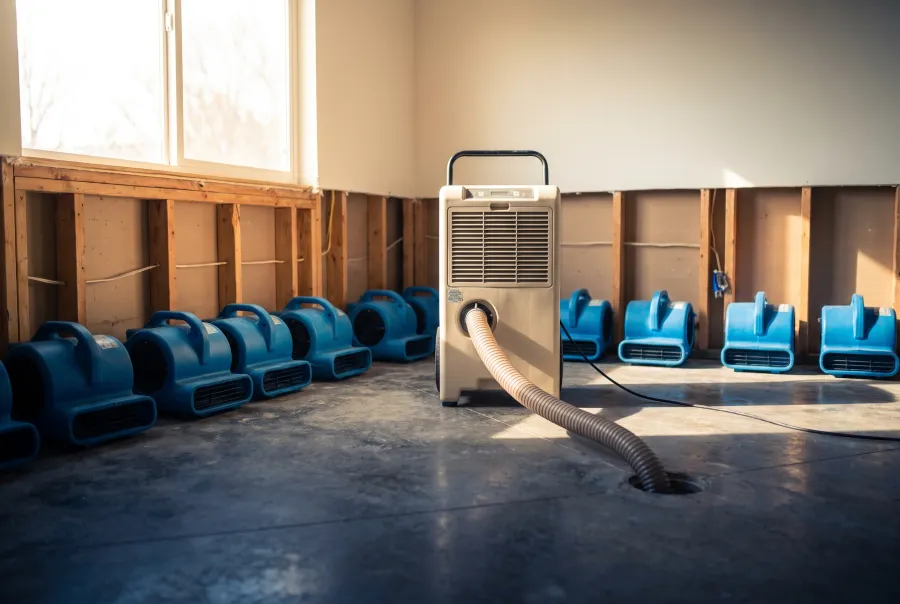
The dehumidifier is the only machine on site that actually removes water from the building. It pulls moist air across a cold coil, condenses the moisture, and drains it away. Air movers without a dehumidifier just move wet air around a closed house.
3 · Temperature
Warmer air holds more moisture and warmer materials release it faster, so a controlled chamber dries quicker than a cold one. This is also why drying slows when equipment is switched off overnight and the space cools down.
4 · Humidity control
We track relative humidity, temperature and grains per pound (GPP) — the absolute amount of water in the air — inside the chamber and outside it. If the air in the room is already near saturation, no amount of fan noise will dry your wall.
What “Dry” Actually Means
A drying goal is a target moisture content for each affected material, established by measuring the same material in an area the water never reached. Dry means the wet area matches that unaffected reference — not a round number, and not how it feels to the touch.
This matters because “dry” is otherwise whatever the contractor says it is. Setting the goal from a dry reference in the same building, on the same material, in the same conditions, is what makes the endpoint checkable by somebody other than us. It is also why we take a reading in an unaffected room on day one — that reading is the benchmark for everything that follows.
| Recorded daily | What it tells you | Why it matters later |
|---|---|---|
| Moisture content per material | How wet the drywall, baseplate, subfloor or framing still is today. | The trend line proves the structure dried, and shows exactly when it hit the goal. |
| Temperature & relative humidity | Whether the drying chamber is set up to keep working. | Explains a slow day — and shows the plan was adjusted rather than left running blindly. |
| Grains per pound (GPP) | The absolute moisture in the air, inside versus outside. | Demonstrates the dehumidifiers were actually pulling water out of the building. |
| Equipment placement & count | What was running, where, and for how long. | Supports the equipment line on the estimate and lets an adjuster verify the scope. |
| Final verification reading | Every affected material at or below its drying goal. | The document that says it was safe to close the wall. Keep this one. |
Documented drying logs are one of the few genuinely hard differentiators in this trade, and they cost the customer nothing extra. If a restoration company cannot hand you a daily record at the end of the job, there is no evidence the building was ever dry — only an assurance that it was.
How a PCH Drying Job Runs
Six stages. The first and the last are the ones that matter most — establishing the goal, and proving you reached it.
Moisture Mapping and Baseline
Pin and pinless meters plus thermal imaging map how far the water actually travelled, including into rooms that look untouched. We take a reference reading from unaffected material of the same type to set the drying goal.
- You will see us reading walls in rooms that were never wet — that is the benchmark
- You get a starting moisture map of every affected material
Deciding What Can Be Dried In Place
Some materials dry; some have to come out. Carpet pad and wet insulation are almost always removed because they hold water and are cheap to replace. Drywall, framing and often hardwood can frequently be saved if we get to them early.
- You will hear the reasoning for each call, material by material
- Small inspection cuts may be made to release trapped moisture from cavities
Building the Drying Chamber
Equipment is placed to a written plan: dehumidifier capacity matched to the volume and evaporation load, air movers angled to sweep wet surfaces rather than point at them, and the affected area closed off so we are conditioning that space and not the whole house.
- You will see air movers aimed along walls at a low angle, not straight on
- Doors and openings may be sheeted to keep the chamber contained
Specialty Drying Where Needed
Wall cavities, hardwood over slab, and enclosed assemblies do not dry from the room side alone. Inject-dry systems push conditioned air directly into the cavity, and floor mat systems pull moisture up through hardwood without lifting it.
- You may see small ports drilled low on a wall, later patched during rebuild
- Mats and hoses across a hardwood floor mean we are trying to save it
Daily Monitoring and Adjustment
We come back every day, take readings on the same points, and record temperature, humidity and GPP. If a material has stalled, the plan changes — more capacity, repositioned airflow, or opening an assembly that is not releasing.
- You get the log each day, not a summary at the end
- A stalled reading triggers a change, not another day of the same
Verification and Equipment Removal
When every affected material reads at or below its goal, we take a final verification set, remove the equipment, and hand over the complete log. Only then does rebuild get scheduled.
- You receive the full daily record, including the final readings
- Nothing is closed up before that verification exists
The Machines, and What Each One Does
Every machine on a drying job does one of three jobs: move air across wet surfaces, remove water from the air, or measure what is happening. Anything that does none of those is decoration.
| Equipment | What it does | When we use it |
|---|---|---|
| LGR dehumidifier | Low-grain refrigerant unit that keeps pulling moisture from air even at low humidity, where a standard refrigerant unit stalls. | The default on most residential and light commercial losses here. |
| Desiccant dehumidifier | Uses an adsorbent wheel rather than a cold coil, so it works in cool conditions and drives very low humidity. | Large losses, cool spaces, and stubborn dense materials like hardwood and concrete. |
| Axial air mover | Moves high volumes of air across broad surfaces to break the saturated boundary layer. | Open floors, walls and large rooms. |
| Centrifugal air mover | Delivers a tighter, higher-pressure stream, useful where air needs directing into a specific area. | Corners, under cabinetry, into cavities and confined assemblies. |
| Inject-dry system | Pushes conditioned air directly into a wall cavity or under hardwood through small ports. | When an assembly cannot dry from the room side and we want to avoid demolition. |
| Pin & pinless moisture meters | Measure moisture content inside materials — pinless scans without marking, pins read at depth. | Every visit, on the same points, to build the trend line. |
| Thermo-hygrometer | Reads temperature, relative humidity and GPP inside and outside the chamber. | Every visit, to confirm conditions still favor drying. |
| Thermal imaging camera | Shows temperature differences that indicate where moisture is likely hiding. | Mapping on day one and re-checking before we call it dry. |
Why Your Job Has More Machines Than Your Neighbor’s
The ANSI/IICRC S500 standard grades a loss by class — how much material got wet and how readily it gives moisture up. Class drives the evaporation load, and evaporation load drives how much dehumidification and airflow the job needs.
| Class | What got wet | Effect on the drying plan |
|---|---|---|
| Class 1 | A small area, mostly low-porosity materials, minimal absorption. | Fewest machines and the shortest plan. Often two to three days. |
| Class 2 | A whole room or more — carpet and pad wet, moisture wicking up the walls. | The typical residential supply-line loss. More airflow, more dehumidification. |
| Class 3 | Water came from overhead, so ceilings, walls, insulation and flooring are all wet. | The heaviest evaporation load. The most equipment and the longest monitoring. |
| Class 4 | Moisture held deep in low-permeance materials — hardwood, plaster, concrete, stone. | Specialty drying. Longer timelines, desiccants, and usually inject-dry or mat systems. |
Category, which grades contamination rather than volume, is covered in depth on the water damage restoration page. Class tells you how big the drying job is; category tells you what has to be thrown away.
What Dries, What Comes Out, and What Surprises People
Density and porosity decide it. Open, absorbent materials that are cheap to replace come out. Dense materials that are expensive to replace are usually worth drying — which is where a meter earns its keep.
- Carpet pad — out. Open cell structure holds water like a sponge and it costs very little to replace. Almost never worth drying.
- Wet insulation — out. Fibrous, slow to dry inside a closed cavity, and it permanently loses R-value once saturated.
- Carpet — usually savable. After clean water caught quickly, carpet can be extracted and dried in place. Contaminated water changes that.
- Drywall — usually savable. If we reach it early and the water was clean, drywall dries. Cut lines get made when it has swelled, delaminated, or the water was contaminated.
- Framing and baseplates — dried. Dense and expensive to replace. This is the material most often still wet when a job is closed too early, because it is the last to release.
- Hardwood over slab — often savable. Cupping is not automatically a death sentence. Mat systems and inject-dry can bring it back, and a floor should be allowed to acclimate before anyone decides to sand or replace.
- Concrete slab — slow. Holds moisture for a long time and releases it gradually. It is the reason a Class 4 job runs long.
How To Help the Drying, and How To Wreck It
Most drying jobs that run long do so because the chamber kept getting disturbed. These are the things that genuinely change the timeline.
Do this
- Leave the equipment running — including overnight and while you are out. Continuous operation is the plan.
- Keep interior doors as we set them — the chamber is deliberate, and an opened door changes the airflow it depends on.
- Run your air conditioning normally — it helps hold the temperature and humidity where drying works best.
- Tell us if a machine trips a breaker — drying stops the moment power does, and hours matter.
- Keep the log we hand you — it is the evidence your building was dried, and adjusters ask for it.
- Ask what today’s numbers mean — we would rather explain the reading than have you wonder why the noise continues.
Do not do this
- Do not switch equipment off for quiet — every interruption resets the curve and adds days, which costs more than the power saved.
- Do not open the windows — under a marine layer this often raises indoor humidity instead of lowering it.
- Do not move the air movers — the angle is set to sweep surfaces; pointed straight at a wall they do much less.
- Do not put furniture back yet — it blocks airflow and traps moisture against the floor you are trying to save.
- Do not close the wall or lay new flooring early — sealing a wet cavity is how a dried room becomes a mold job.
- Do not accept “it looks dry” as the endpoint — from anyone, including us. Ask for the reading.
Drying a Building in Coastal Orange County
Most drying advice online is written for a climate with basements and freezing winters. Orange County has neither, and two local conditions change the drying plan in ways national guidance does not cover.
The marine layer works against you
The standard homeowner instinct — open the windows and let it air out — is often counterproductive here. On a morning when the marine layer is in across Corona del Mar, Newport Coast, Dana Point or Capistrano Beach, the outdoor air can hold more moisture than the air already inside the house. Opening up then does not dry the building; it imports water vapor. This is exactly why we measure GPP inside and outside rather than guessing, and why a closed, dehumidified chamber beats fresh air on a damp coastal morning.
Slab-on-grade changes where the water sits
Almost every home in Laguna Hills and OC is built on a concrete slab rather than over a basement or crawl space. Water does not pool below the living space and get pumped out — it spreads sideways across the slab, soaks the carpet pad, and wicks upward into the baseplate and the bottom of the drywall. The bottom twelve to twenty-four inches of wall is where the moisture ends up, and the baseplate bolted to the slab is the last thing in the building to dry.
In the 1960s–80s Moulton Ranch tracts and the older Saddleback Valley housing around them, that pattern is compounded by slab leaks in the original copper supply lines, where water arrives from underneath the slab rather than above it. Those jobs almost always run longer, because concrete releases moisture slowly and the source has to be fixed by a plumber before drying can finish.
Why the Drying Log Matters To Your Claim
Drying is usually the most scrutinized line on a water damage estimate, because it is billed by equipment and by days. A daily log showing readings, conditions and equipment placement is the difference between a documented scope and a disputed one.
Adjusters are not being obstructive when they question equipment days. They are being asked to pay for machines they never saw, in a house they may never visit. A record showing that eight machines ran for four days, that the readings fell each day, and that the equipment came out the day the goal was met, answers that question before it is asked.
What we do
- Document daily — readings per material, chamber conditions, equipment count and placement.
- Record the drying goal and its source — so the endpoint is defensible rather than asserted.
- Coordinate with your adjuster — and explain what was dried in place instead of removed, which usually reduces the claim.
What we do not
- Promise what your carrier will pay — coverage is between you and your policy.
- Leave equipment running to inflate days — the log makes that visible, which is part of why we keep it.
- Close a wall to hit a schedule — if the reading is not there, the wall stays open.
Broader policy questions are covered on our full FAQ page.
Structural Drying Questions, Answered
Mostly asked on day three, when the machines are still running and nothing appears to be happening.
How long does structural drying take?
Three to five days is typical for a contained clean-water loss in drywall and framing. Hardwood, plaster, concrete, and anything in a sealed cavity take longer. The equipment comes out when the meter reaches the drying goal, not when a set number of days has passed.
It feels dry to me. Why is the equipment still running?
Surfaces dry first and hold almost no water. The moisture that matters is inside the drywall, the baseplate, the subfloor, and the framing. A material can feel completely dry to your hand while a pin meter still reads well above the target for that material.
Can I just open the windows and run my own fans?
Often that makes it worse here. Under a coastal marine layer, outdoor air can carry more moisture than the air already inside, so opening up raises humidity instead of lowering it. Household fans move air but remove no water; a dehumidifier is what actually takes moisture out of the building.
What is a drying goal, and who decides it?
It is a target moisture content for each affected material, set by measuring the same material somewhere the water never reached. That unaffected reading is the benchmark. Dry means the wet area matches the dry reference, not an arbitrary number chosen by the contractor.
Why are there so many machines in my house?
Equipment count follows the class of loss, which reflects how much material got wet and how fast it can release moisture. A Class 3 loss with wet ceilings, walls, and flooring has a far larger evaporation load than a small Class 1 area, so it needs more air movers and more dehumidification.
Do you have to remove my hardwood floor?
Not always. Hardwood that has cupped but not crowned or delaminated can frequently be dried in place using floor mat systems or inject-dry, then allowed to acclimate before any decision about sanding. We take a reading before recommending removal, because a lot of savable floors get torn out unnecessarily.
What do the daily moisture logs actually show?
For each affected material, its moisture reading that day, plus temperature and relative humidity in the drying chamber and equipment placement. Together they show the trend line proving the structure is drying and, at the end, that it reached the goal. That record is what an adjuster wants.
What happens if a wall gets closed up before it is dry?
Trapped moisture has nowhere to go, so it stays in the cavity against the baseplate and framing. The EPA advises drying water-damaged materials within 24 to 48 hours to prevent mold growth, and a sealed wet cavity fails that test permanently. It usually reappears months later as an odor or a stain — and then it is a mold remediation job.
Is the equipment noisy and expensive to run?
Yes to noisy, and it does add to your power bill while it runs. Please do not switch it off overnight. Every interruption resets the drying curve, extends the total number of days, and often costs more than the electricity saved.
Is structural drying separate from water damage restoration?
It is the middle phase of it. Emergency extraction removes the standing water, structural drying removes what soaked into the building, and reconstruction replaces what could not be saved. We handle all three, so nothing gets closed up before it is verified dry.
Want To Know If It Is Actually Dry?
We will take a reading and tell you honestly — including when the answer is that you do not need us.